The Everyday Home Reset: a Simple 3-Part Routine

If your house feels like it’s getting ahead of you lately, you don’t need a whole-house overhaul—you need a simple reset that actually holds. I don’t know who needs to hear this today, but you don’t have to fix your whole house to feel better in your home. Most of us don’t actually need a dramatic overhaul. We need a little stability.
Because no matter what you do, real life keeps happening.
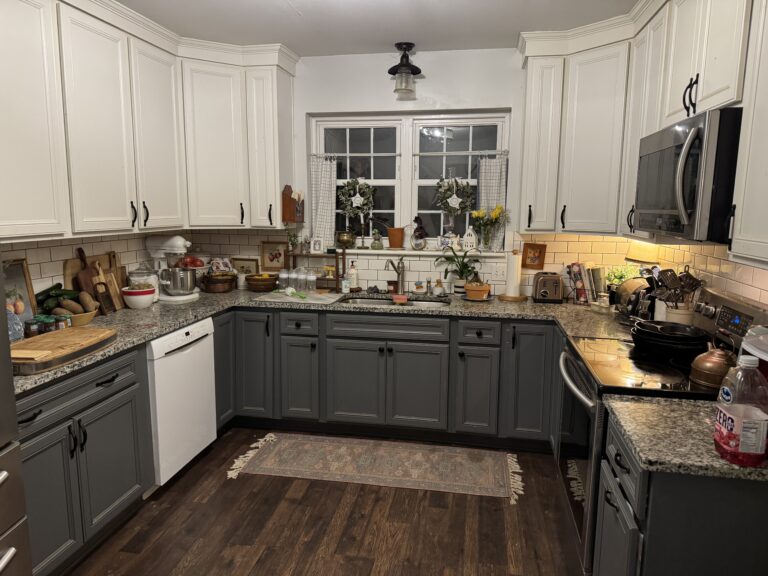
You can clean for two hours, turn around, and the kitchen looks like you never touched it. Someone drops the mail on the counter. Shoes appear in the hallway like they multiplied overnight. You walk by with an armload of laundry and think, “I’ll be right back.” (And then you’re don’t.)
If you’ve been feeling behind, scattered, or like your home is always one step away from chaos… you’re not failing. You’re just living a full life. That’s a good thing! Life isn’t supposed to be neat and tidy all the time. Life is messy and full of surprises and your home reflects that. Some days feel hard, because they are hard.
One of my favorite Bible verses is Lamentations 3:22-23 which says: “His mercies are new every morning.” It’s not just a nice verse for a pretty graphic. It’s a promise. You get to begin again—today, tomorrow, and every day after that.

What I want to share with you in today’s post is a simple reset method I use when I need my home to feel steady again—without turning it into a giant project.
This is a home reset, not a deep clean
Let’s define what we’re doing here: A reset is what you do to get the house back to “livable” and “peaceful enough” so you can function.
A deep clean is what you do when you’ve got extra time, extra energy, and you want to scrub baseboards and clean behind the fridge.
If you’re tired, overwhelmed, or just in a busy season, you probably don’t need everything plus the baseboards clean. If you’re anything like me, you just need your home to stop feeling like it’s closing in on you. So, we’re going to focus on a few things that will help your home feel manageable again in the fastest way possible.
The Everyday Home Reset
You don’t need to do everything. You just need to do a few things… in the right order.
That order matters more than most people realize. Because when you start in the wrong place, you work hard and still don’t feel better about how your home looks and feels – and runs.
I’ll be honest—this is what used to happen to me: I’d pick the biggest mess (or the most embarrassing mess haha), attack it with a burst of motivation, and then feel completely worn out. And because I was worn out, I didn’t keep up with the small daily things that actually hold a house together – my downfall every. single. time.
So then a day or two later, my house was right back where it started – cluttered, messy, and looking like I had not done anything productive all week.
And it wasn’t because I didn’t care or that I was lazy. It was because I didn’t have a simple routine to fall back on.
And that’s exactly what this method gives you.
The 3 parts that stabilize a home the fastest
- Kitchen rhythm (because it touches everything)
- Daily reset habit (because consistency beats intensity)
- Weekly anchor routines (so it doesn’t all fall apart again)
If you do these three things, your home will start to feel calmer – even if the rest of the house isn’t perfect. (And it won’t be. That’s fine.)
Let’s walk through each one of these steps:
1) Start with a kitchen rhythm (this is the fastest win)
The kitchen is the busiest room in the entire house. When the kitchen is out of control, everything feels harder: feeding people, getting out the door, even just making coffee without being annoyed.
When I walk into the kitchen to prepare a meal, I don’t feel like I can start cooking unless the kitchen is clean – so if it’s a mess, the first thing I’ll do is clean before cooking. Maybe you’re the same way. And worse, if I walk into a messy kitchen in the morning because I didn’t close down the kitchen the night before? I feel defeated before the day even starts.
A kitchen rhythm is not “a spotless kitchen.” It’s a simple pattern that keeps it from becoming a disaster zone. Here’s a basic kitchen reset you can do in 10 minutes:
The 10-minute kitchen reset
- Clear the sink (or at least make it usable)
- Load or unload the dishwasher (whichever needs done)
- Wipe one main counter
- Toss trash and gather stray dishes
- Do a quick sweep of the counters if crumbs are driving you crazy
That’s it.
If you only do one thing today, do this: make your kitchen sink usable.
It sounds too simple, but it changes the whole feel of the room. And once the kitchen feels under control, your brain can relax a little more.
2) Add a daily reset habit (10–15 minutes, that’s all)
This is the part that makes the difference long-term. Most homes don’t fall apart because nobody ever cleans.
They fall apart because little things get set down… and then left there. And once one little pile appears, it quietly gives everyone permission to add to it. (If you’ve ever noticed how clutter “breeds,” you know what I mean.)
The Broken Window idea (from Wilson and Kelling’s 1982 essay) is basically this: when a space shows small signs of neglect, it can quietly signal “nobody’s tending this,” and more disorder tends to follow. (The Atlantic)
Now—this theory is debated in criminology (and especially how it was used in policing). Researchers have pointed out the relationship between visible disorder and serious outcomes isn’t always simple or direct. But the “small signals create momentum” part? That applies to homes perfectly.
In a house, your “broken window” is usually something like:
- the sink that stays full “just for tonight”
- the one chair that becomes the clothes chair
- the pile by the door that turns into a whole little ecosystem
Once one spot becomes the default, it gives everyone (including you) a subtle cue that says, “This is normal right now.” And then it spreads—not because you’re lazy, but because your brain is tired and you’re trying to get through the day.
That’s why I’m such a believer in a daily reset. Not because your house needs to be perfect, but because you’re gently “fixing the first broken window” so the mess doesn’t start rolling downhill.
The daily reset is what keeps the first “broken window” from becoming a whole street of broken windows. You’re basically saying: We’re not letting the mess start tonight.
Choose one time anchor
Pick a time that already exists in your day: (here are some examples)
- right before supper
- right after supper
- right before you go to bed
You don’t need a perfect schedule. You need a reliable moment.
The simple daily reset
- Close the kitchen (dishes, counters, sink)
- Pick up the main living area (5 minutes—set a timer)
- Put things back where they belong as you go
And if you want a simple rule to repeat (to yourself and everyone else):
Don’t set it down—put it away.
You don’t have to do this perfectly. You just have to do it often enough that your home stops sliding downhill every day.
3) Use weekly anchor routines
Weekly anchors are small routines that happen on certain days so you’re not constantly wondering what you should be doing. They keep the basics handled without you carrying it all in your head.
This isn’t about a rigid cleaning schedule. It’s about touching the main areas of your home on purpose so they don’t become emergencies.
A simple example of weekly anchors
Use this as inspiration—adjust it to your life:
- Monday: bathrooms (clean + scrub)
- Tuesday: floors (vacuum + sweep)
- Wednesday: kitchen focus (fridge check, wipe fronts, one drawer)
- Thursday: laundry catch-up + bedding
- Friday: “weekend ready” reset (tidy, prep, straighten)
Your anchors can be even smaller than that. The point is: you’re not trying to do everything all the time. You’re just keeping your home from getting away from you.
If you only have 25 minutes today, do this
Here’s a simple plan you can follow without thinking too hard:
- 10 minutes: kitchen reset (sink + one counter)
- 10 minutes: pickup in the main living area (timer on)
- 5 minutes: set up tomorrow (coffee station, backpacks, start one laundry load)
Then stop. That’s it! Go sit down. Drink your tea. Read your Bible. Take a shower. Do something that makes you feel like a human again. A reset should support your life—not consume it.
Do this every day you’re able – this 3 part Home Reset should become a daily habit.
What if you fall off again?
There will be days you don’t get it done. Either the day was too busy or maybe your household caught the flu. That doesn’t mean it didn’t work. It just means you’re not a robot.
When you fall off, don’t restart with a giant project. Restart with the kitchen. Make the sink usable. Clear one counter. Close the kitchen tonight.
And remember: His mercies are new every morning. You’re allowed to begin again without shame.
Want the full plan (with checklists and step-by-step guidance)?
If this post helped you breathe a little, but you’re thinking, “I need more structure than this”… that’s exactly why I created The Everyday Home Reset Workbook.
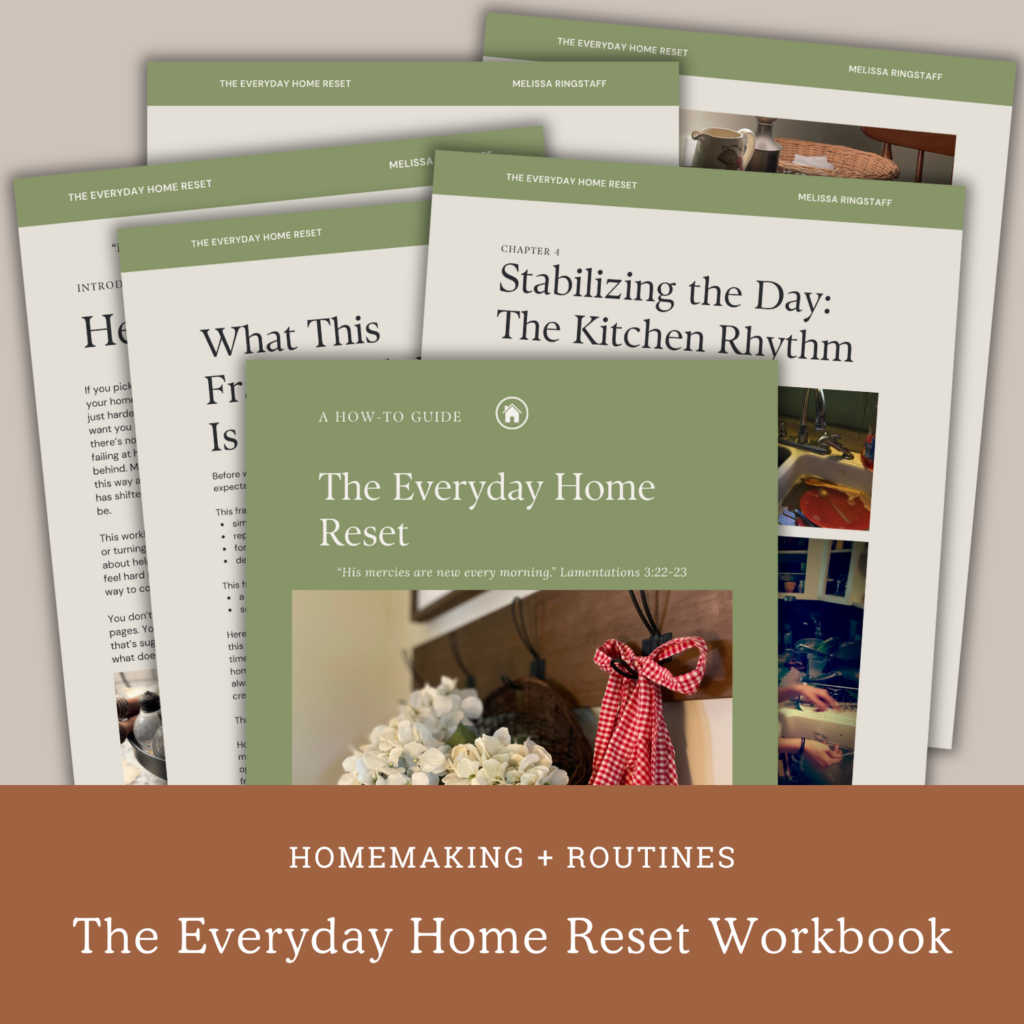
Inside the Workbook You’ll Find:
- 46 page digital .pdf workbook
- A clear, step-by-step reset sequence (so you’re not guessing)
- Kitchen rhythm reset guidance (the fastest stabilizer in most homes)
- A simple 10–15 minute daily reset plan
- Weekly anchors you can customize to your own life and schedule
- A gentle decision gate for when resets aren’t working because the home is over capacity
Inside The Homemaker’s Society, you don’t just get ideas. You get a plan you can follow when you’re tired:
- the reset sequence laid out step-by-step
- simple checklists (so you’re not guessing)
- weekly rhythm support and accountability
- encouragement that feels like a steady hand on your shoulder, not pressure
If you’d like to join us, you can become a member of The Homemaker’s Society and get access to the full workbook and support.
And if you’re here from my free Facebook group—hi. I’m so glad you’re here. This is the kind of steady, real-life homemaking encouragement I love to share.
Before you go…
Tell me in the comments: What’s one area that would make your home feel calmer if it was reset today? Kitchen? Living room? Entryway? Laundry?
Start there. Keep it small. And let today be enough!
Free Printable Worksheets
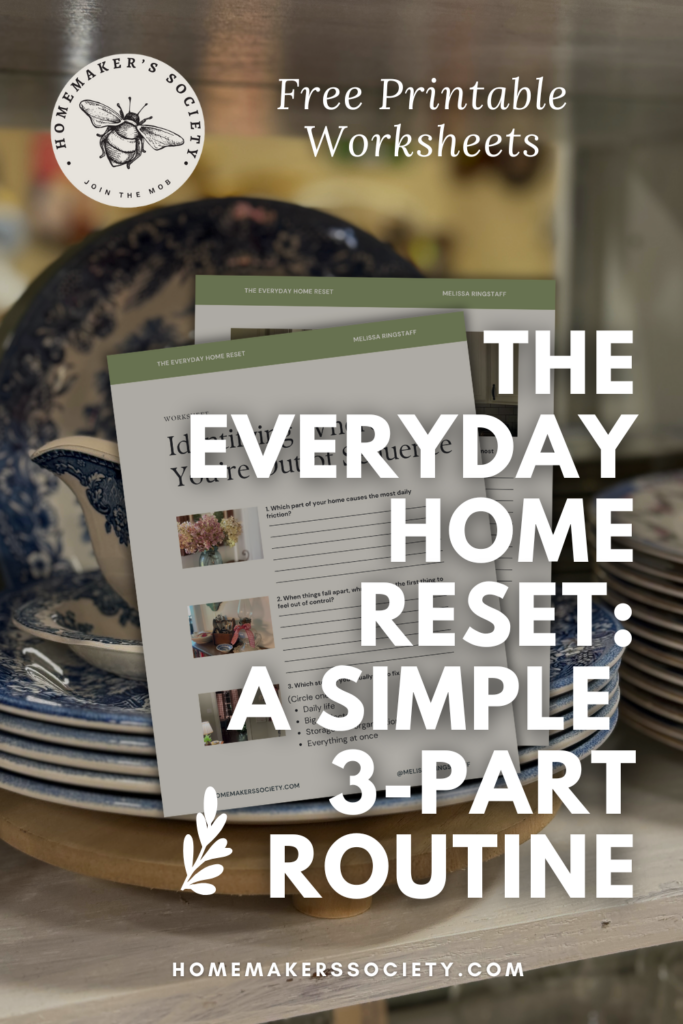
Be sure to download my free printable worksheets: Identifying Where You are Out of Sequence (pages 15-16 of the workbook). Just fill out the form below!
These worksheets are from the full workbook: The Everyday Home Reset on sale in my shop!

How to Download
- If you’re a member of The Homemaker’s Society, you’ll find your link to download the full workbook, The Everyday Home Reset Workbook Notebook below.
- Become a member of The Homemaker’s Society. and you’ll get instant access to this printable and hundreds of other helpful resources for your home as part of your membership.
- FREE Worksheets for non-members! If you aren’t ready to become a member yet, just fill out the form below and you’ll get your free printable (excerpted from the full workbook) sent straight to your inbox!
- OR, you can purchase the The Everyday Home Reset Workbook here!
Members Only Download here
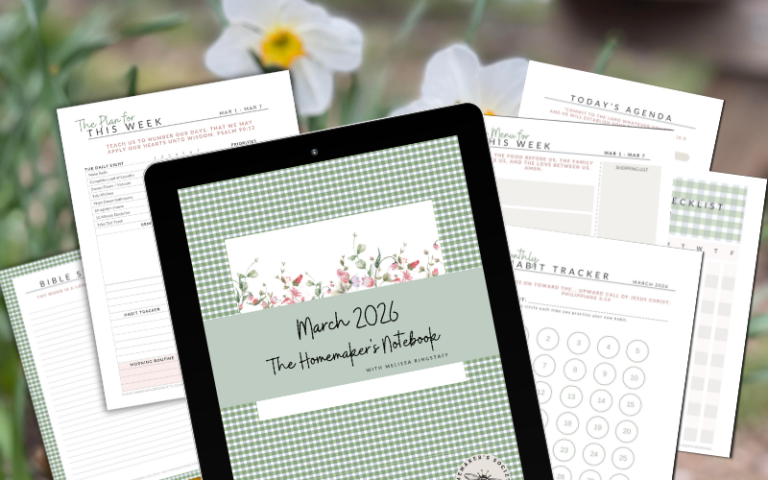
Just click on the link below to download your notebook. Don’t forget that you can find this and hundreds of printables in the Resource Libraries!





hi Melissa! the link for the free download does to the shopping page. was it supposed to start a download instead?
Hi Melissa, the link for the ‘Everyday home reset workbook’ from the members page doesn’t seem to work. I am a member, but it keeps taking me to the payment page. I was under the impression that the workbook was free to members.
Thanks for your great work
Natalie
Hi Natalie! I’m not sure what happened. I sent you an email so we can try to troubleshoot. Thanks for letting me know. I sent the workbook in the email to you. 🙂