How to Cut Hidden Household Expenses — Finding the Money You Didn’t Know You Were Spending

The money isn’t missing. It’s hiding. That’s the thing about hidden household expenses — they don’t feel like spending. They feel like nothing. They’re automatic, invisible, or small enough to ignore individually. But they add up. And when you sit down with your bank statement and wonder where the money went, these are usually what you’re looking at.
I’m not going to give you a list of 275 frugal tips. I’m going to tell you where the money is actually going in most homemaker households — the specific places it quietly drains out without you noticing — and exactly what to do about it.
The Subscription Drain
This is almost always the biggest surprise when a family sits down and actually counts their subscriptions. Most households are paying for three to five streaming services, a gym membership no one uses, a meal kit delivery they signed up for during a promotion and forgot to cancel, two different cloud storage plans, an app subscription from two phones ago, and at least one free trial that converted to paid months back.
Individually, none of these feel like much. Together, they can easily run $150-$300 a month — money that is leaving your account automatically, every month, without a single decision being made.
What to do: Pull up your bank or credit card statements from the last two months. Highlight every recurring charge. Write them all down in one place — your subscription tracker in your household notebook is exactly what this is for. Then go through them one by one and ask: are we actually using this? When did we last use it? If the answer is “I’m not sure” — cancel it. You can always resubscribe if you miss it.
Do this once a year at minimum. Subscriptions multiply quietly and companies count on you not noticing.
The Convenience Premium
A convenience premium is the extra money you pay to not have to think about something. It’s the pre-cut vegetables instead of the whole ones. The individually packaged snacks instead of buying in bulk and portioning yourself. The name brand because you didn’t have time to compare. The drive-through because dinner wasn’t planned.
None of these choices are wrong in isolation. A woman managing a household and children and a hundred other things deserves convenience sometimes. But when convenience becomes the default rather than the occasional exception, the premium adds up fast.
The antidote to the convenience premium is preparation — not perfection, just preparation. Meal planning removes the drive-through decision. Keeping a stocked pantry removes the “we have nothing to eat” emergency. Buying staples in bulk removes the need to grab the expensive small package because you ran out.
What to do: Identify the two or three places in your week where you most consistently pay the convenience premium. Just two or three — not all of them. Make a plan for those specific moments. If Thursday is the day dinner always falls apart, plan Thursday differently. If you always grab pre-packaged snacks because you haven’t prepped anything else, spend twenty minutes on Sunday making something. Start there and only there.
The Phantom Utilities
Most families have no idea what their utilities actually cost month to month — they just pay the bill. But utilities are one of the places where small habits create real savings over time without any sacrifice in comfort.
Heating and cooling are the biggest. The thermostat you set to 72 degrees and never think about again is costing you more than it needs to. A programmable thermostat that drops the temperature overnight and while the house is empty can save $100-$200 a year with zero effort after the initial setup.
Water is the other one most families overlook. Long showers, running the dishwasher half full, washing laundry in hot water when cold works just as well — these are habits that cost real money over the course of a year.
What to do: For one month, pay attention to your utility usage without changing anything — just notice. Then pick one habit to change. Just one. Run the dishwasher only when it’s full. Wash laundry in cold water. Turn the thermostat down two degrees at night. See what it does to your bill. Small changes in high-frequency habits compound faster than you expect.
The Grocery Drift
Groceries are the category most homemakers feel the most guilt about because it’s the one they feel most responsible for — and the one with the most genuine variability. Some months are just more expensive than others. Produce goes bad. Company comes. The children go through a growth spurt.
But grocery drift — the slow, unnoticed increase in the grocery bill over months and years without any corresponding increase in what you’re actually buying — is real and worth paying attention to.
Grocery drift happens for a few reasons. Brand loyalty to products that have gotten more expensive when the store brand is identical. Buying what looks good at the store rather than what’s on a list. Shopping when you’re hungry. Adding things to the cart that feel small in the moment but aren’t.
What to do: Shop with a list every single time. This one habit alone can reduce a grocery bill by 15-20% without cutting anything you actually use. A list isn’t about restriction — it’s about intention. You decide what you need before you’re standing in front of a display designed to make you want things you didn’t come for.
Also: compare unit prices, not package prices. The bigger size is almost always cheaper per unit but not always. The store brand is almost always identical to the name brand and significantly cheaper. These two habits cost nothing but attention.
The Unused and the Duplicate
Most households are paying for things they already own or already have access to. A gym membership when there’s equipment in the garage. A subscription recipe service when there are cookbooks on the shelf. A productivity app when a paper planner works fine. A premium streaming service for one show when that show ended two seasons ago.
Duplicates are the other version of this — two subscriptions that do the same thing, two memberships to the same type of service, two of something you only need one of.
What to do: Walk through your subscriptions and ask: do we already have something that does this? Do we have a free version of this that we’re paying for? Do we need both of these or just one? Cut one. Then cut another.
The Small Daily Purchases
I’m going to be careful here because this is the category that shows up in every single frugal living article as “stop buying coffee” — and I think that advice is both reductive and annoying. One coffee is not the reason your budget is tight.
But the pattern behind the daily purchase habit is worth looking at. It’s not the coffee. It’s the coffee plus the snack plus the small convenience purchase plus the impulse add-on while you’re waiting. It’s the habit of spending a small amount of money multiple times a week without thinking about it, and the way those small amounts add up to a number that would surprise you if you added it up.
What to do: For one week — just one — write down every purchase under $20. Every single one. Don’t change anything, just record it. At the end of the week look at the total and look at the pattern. You’ll know immediately where the small daily spending is going and whether it reflects your actual values and priorities. Then decide what to keep and what to cut. The goal isn’t to eliminate all small pleasures. The goal is to make the decision on purpose instead of by habit.
The Insurance and Bill Creep
Insurance premiums, internet bills, phone plans, and bank fees increase slowly and quietly over time. Most people pay whatever the bill says without checking whether they’re still getting a competitive rate. Companies count on this.
Car insurance, in particular, can vary dramatically between providers for identical coverage. Homeowners insurance is the same. Internet and phone plans add features and fees over time that you may not have noticed or authorized.
What to do: Once a year — the same time you review your subscriptions — call your insurance provider and ask if there’s a better rate available. Call your internet provider and ask about current promotions. Check whether your bank is charging any fees that could be avoided. These calls take twenty minutes each and can save hundreds of dollars a year.
Also: if you haven’t shopped your car insurance in the last two to three years, get a competing quote. You may be paying significantly more than you need to.
The Framing That Makes This Work
I want to say something before you go through this list and feel guilty about every one of these things in your own household.
This isn’t about deprivation. The goal of cutting hidden expenses is not to make your life smaller — it’s to make your spending more intentional so that the money you do spend goes toward things you actually value. Every dollar you stop spending on a subscription you forgot about is a dollar available for something that matters to your family.
The wise homemaker doesn’t spend less because she has to. She spends wisely because she knows that money is a resource to be stewarded, not just consumed. And stewarding it well means knowing where it goes.
That’s what this is. Not frugality for its own sake. Wisdom in the service of your family’s flourishing.
A Worksheet to Help You Find It
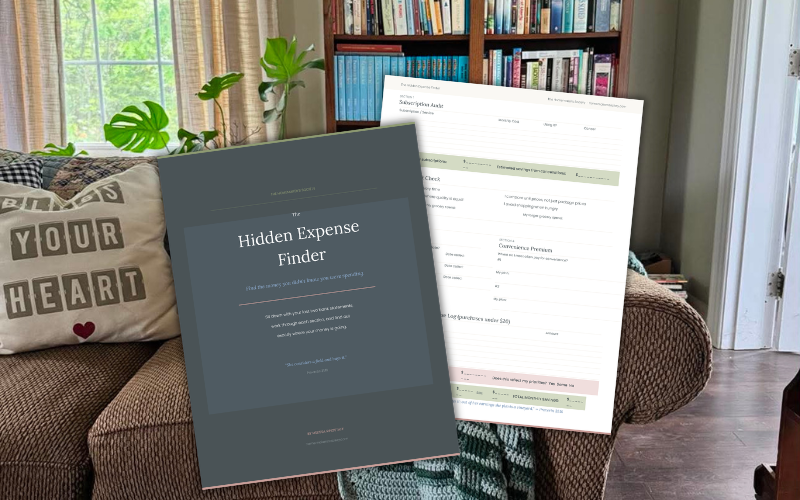
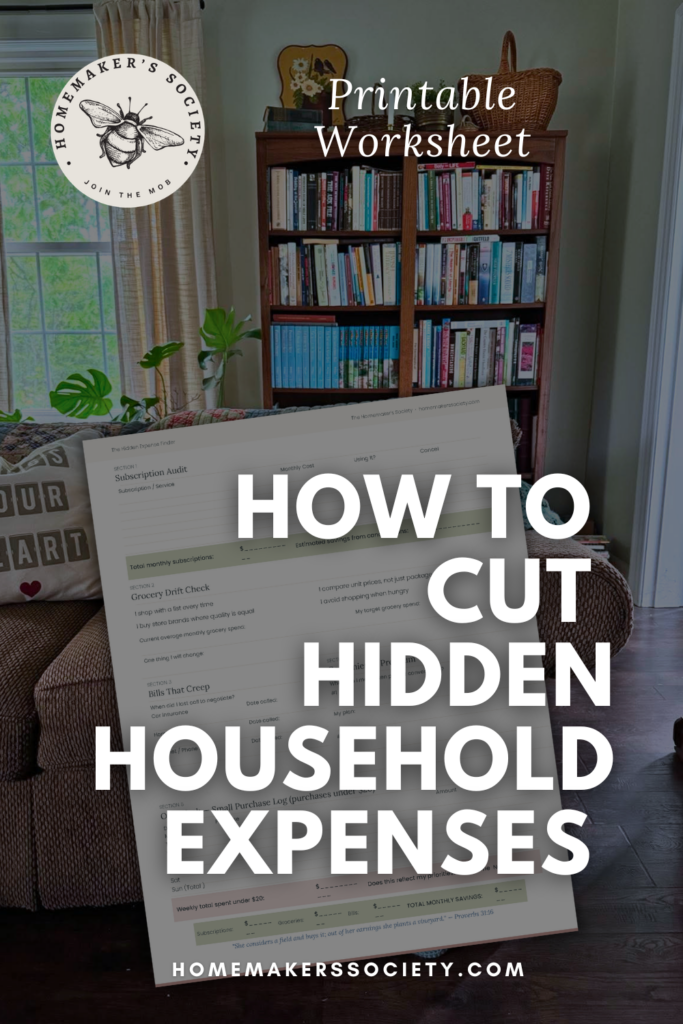
I made a printable to go with this post — it’s called the Hidden Expense Finder and it walks you through each section we covered here in one place.
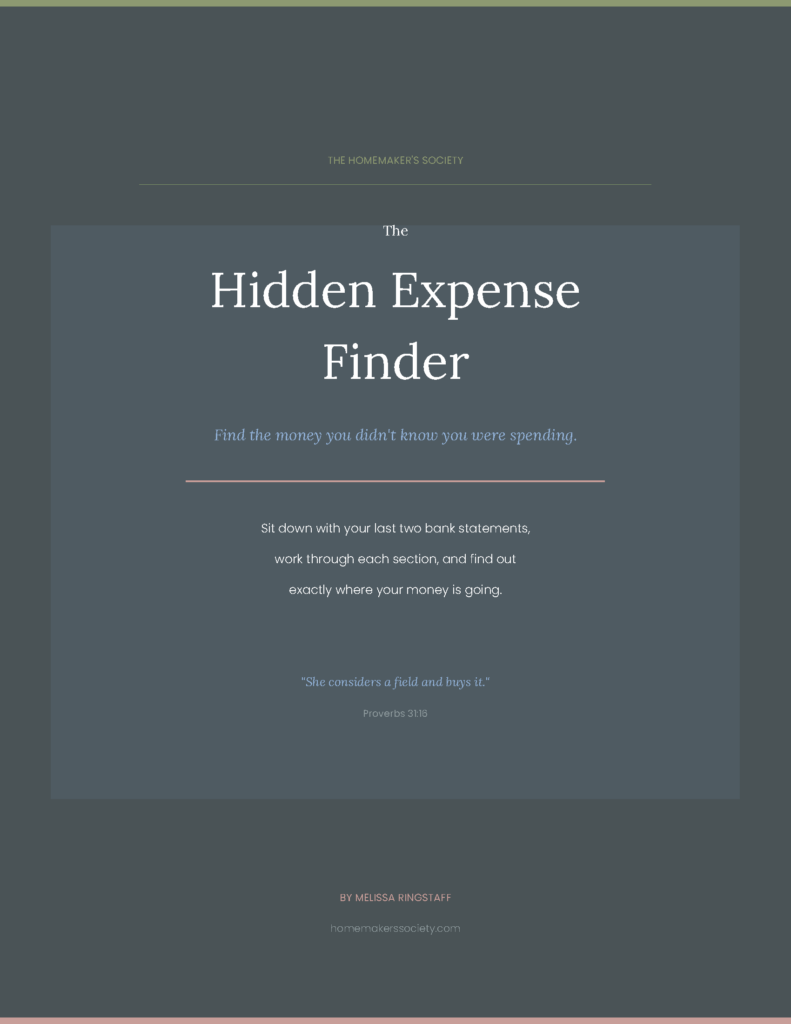
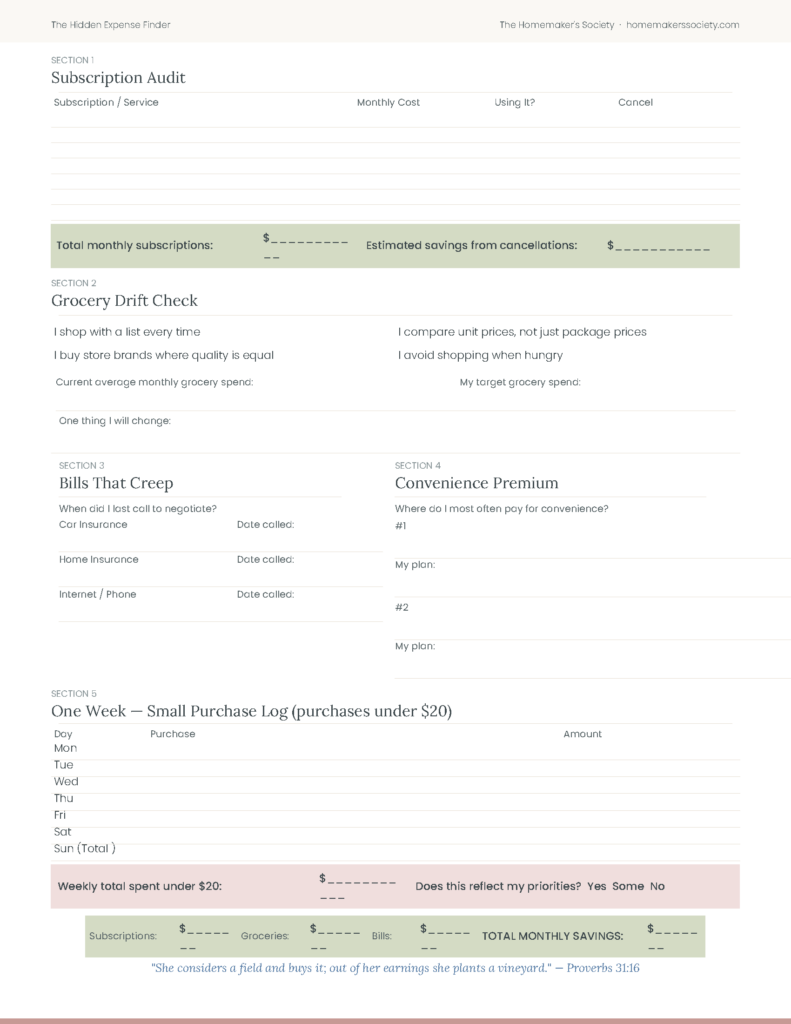
It has a subscription audit table so you can list every recurring charge and decide what to cancel, a grocery drift checklist, a spot to name your convenience premium habits and make a plan for each one, a bill review section with a place to record when you last called to negotiate, a one-week small purchase log, and a simple savings summary at the bottom so you can see exactly how much you found.
Print it out, sit down with your last two bank statements, and work through it. That’s it. You don’t need a spreadsheet or an app or a complicated system. Just this one page and twenty minutes of honest attention.
Members find it in the Fireside Room under Home Economy + Budgeting. And if you’re not yet a member, you can also find the Wise Homemaker Financial Protection Workbook in the shop — a more complete resource that covers your family’s full financial picture, including spending plan pages, insurance records, important documents, and an emergency action plan.
Members: find the Hidden Expense Finder in the Fireside Room →
Get the Wise Homemaker Financial Protection Workbook in the shop →