
What Every Homemaker Should Know About Her Family’s Finances

A few years ago, a woman I know lost her husband suddenly. He was in his fifties. Healthy, as far as anyone knew. And then one morning, he was gone. She was a homemaker. Had been for over twenty years. She loved her life, loved her husband, loved her home. But in the weeks after he died, she discovered something that added a layer of grief to an already unbearable season: she didn’t know where anything was.

She didn’t know which bank held their accounts. She wasn’t sure if there was a will. She knew there was life insurance somewhere but couldn’t find the policy. She had no idea how to access their retirement accounts or what they contained. She had given her whole adult life to her home and her family — and in the moment she needed to understand her financial position most, she was starting from scratch.
I’m not telling you that story to frighten you. I’m telling you because I think about her often when I talk to women about homemaking. Because what every homemaker should know about her family’s finances is something most of us were never taught — and most of us never think about until we need it.
I also have a friend I’ve know for over 20 years. She and I connected way back when because of our love of being a homemaker and homeschool mom of a bunch of kids. After 30 years of being a stay at home mom and married to a man she trusted, he ended up leaving her for another woman. My friend had her teaching degree to fall back on and she’s now working as a teacher.
I asked her the other day if she regretted staying home and raising her kids in light of her impending divorce. She said, “Are you kidding me? I will never regret staying home with my kids.”
Knowing Your Family’s Finances as a Homemaker
This isn’t about distrust. It’s not about assuming the worst. Remember, the Proverbs 31 woman considered a field and bought it. She knew what her household was worth. She was not financially naive, and she was not passive about the stewardship of her family’s resources. She was wise.
That’s what this is. Wisdom. Sometimes we do everything in our power to build a life based on trust and faith and bad things still happen. The good news is, we don’t need to live in a fear. Regardless of what happens, God is faithful to provide for your needs.
“My God shall supply all of your needs according to His riches in glory by Christ Jesus.” Philippians 4:19
But there are some wise decisions you can make to help protect yourself in the event something unexpected happens.
#1 Know Where Everything Is
This is the most basic and most overlooked piece of financial wisdom for homemakers. You don’t have to manage every account. But you need to know they exist and how to access them.
Sit down with your husband and make a list together. Where are your bank accounts? What credit cards does your family carry? Where is the mortgage held? Where are the retirement accounts — his, and yours if you have them? Where is the life insurance policy? Where is the will? Where is the deed to your home?
If any of these questions made you pause, that’s your starting point.
The goal isn’t for you to manage these things if that’s not your role in the marriage. The goal is for you to know where they are. A filing cabinet you’ve never opened is not financial partnership — it’s financial vulnerability. You need to be able to find these documents on your own, in a moment of stress or grief, without having to ask anyone for help.
The Homemaker’s Financial Document Checklist — know where to find each of these:
- Bank account numbers and institution names
- Credit card accounts
- Mortgage documents and account information
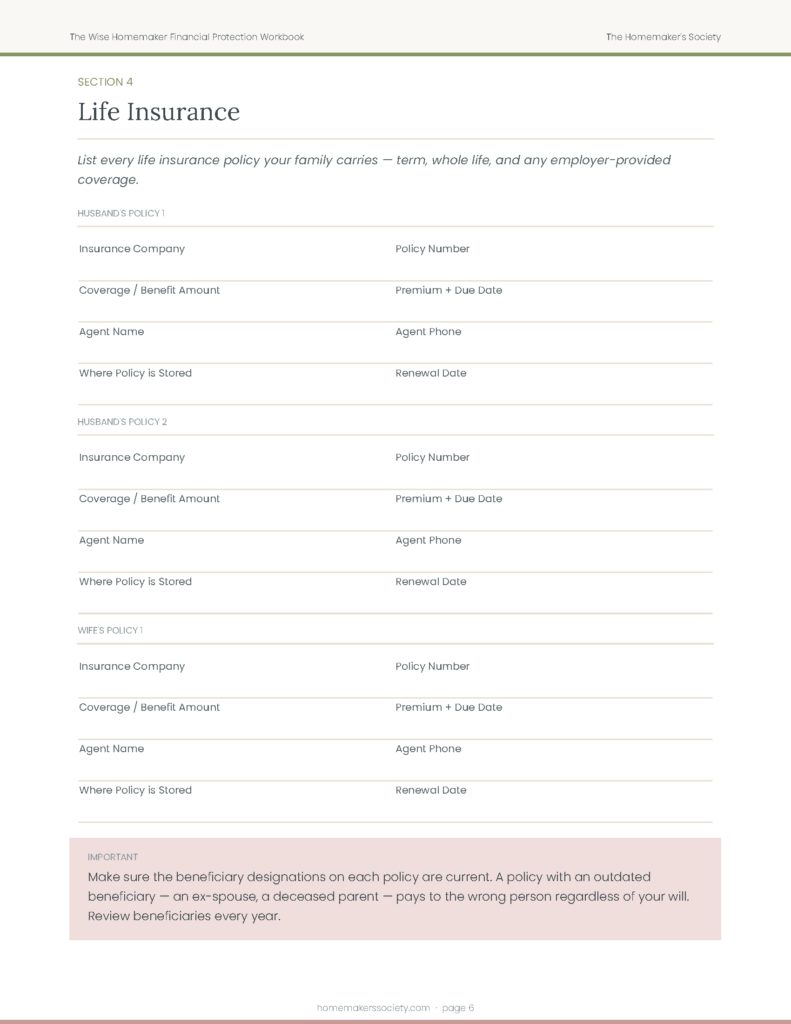
- Life insurance policy — company, policy number, benefit amount
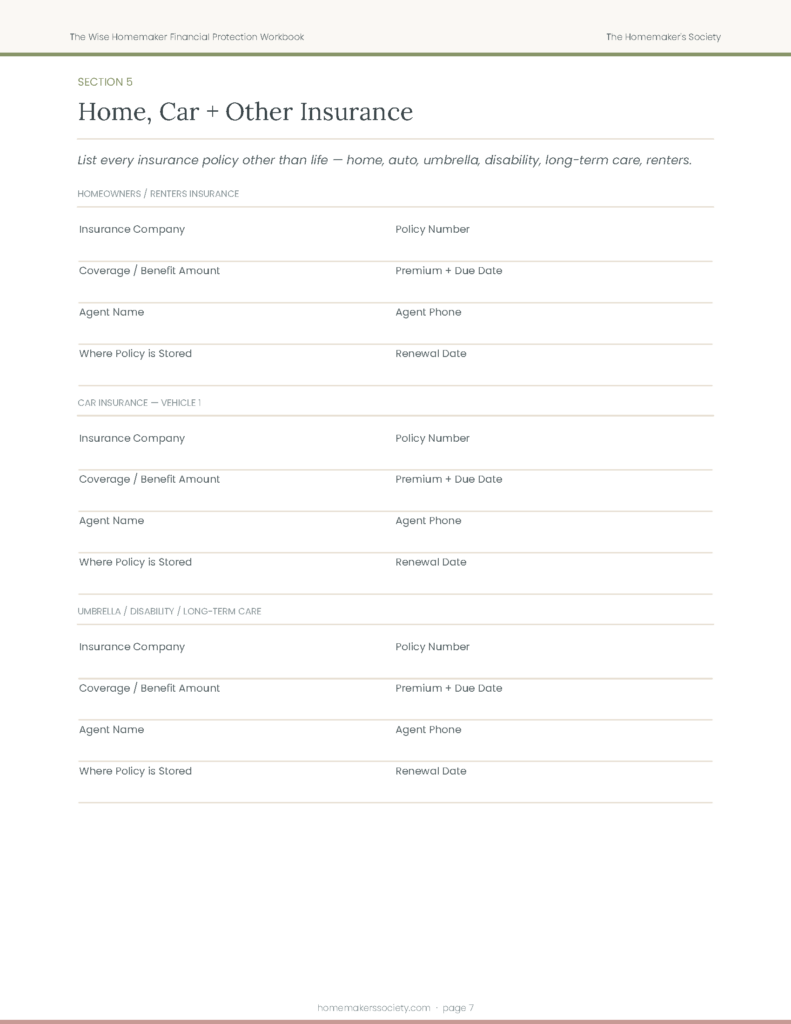
- Any other insurance policies (disability, long-term care)
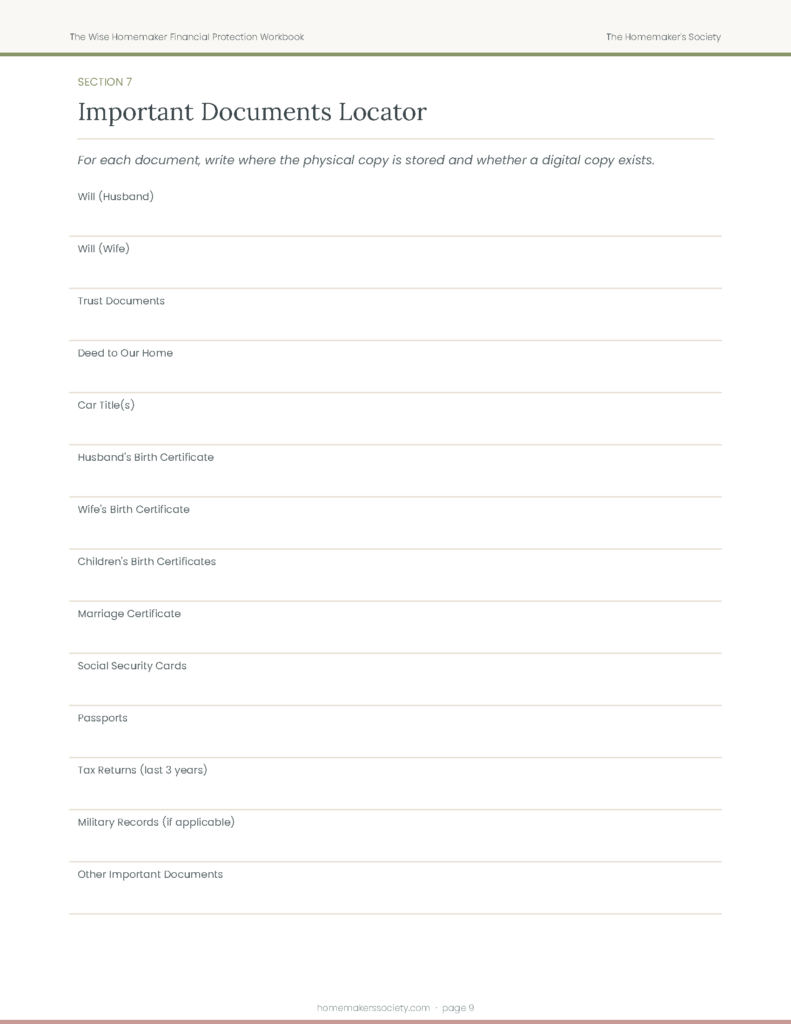
- Will and/or trust documents
- Deed to your home
- Car titles
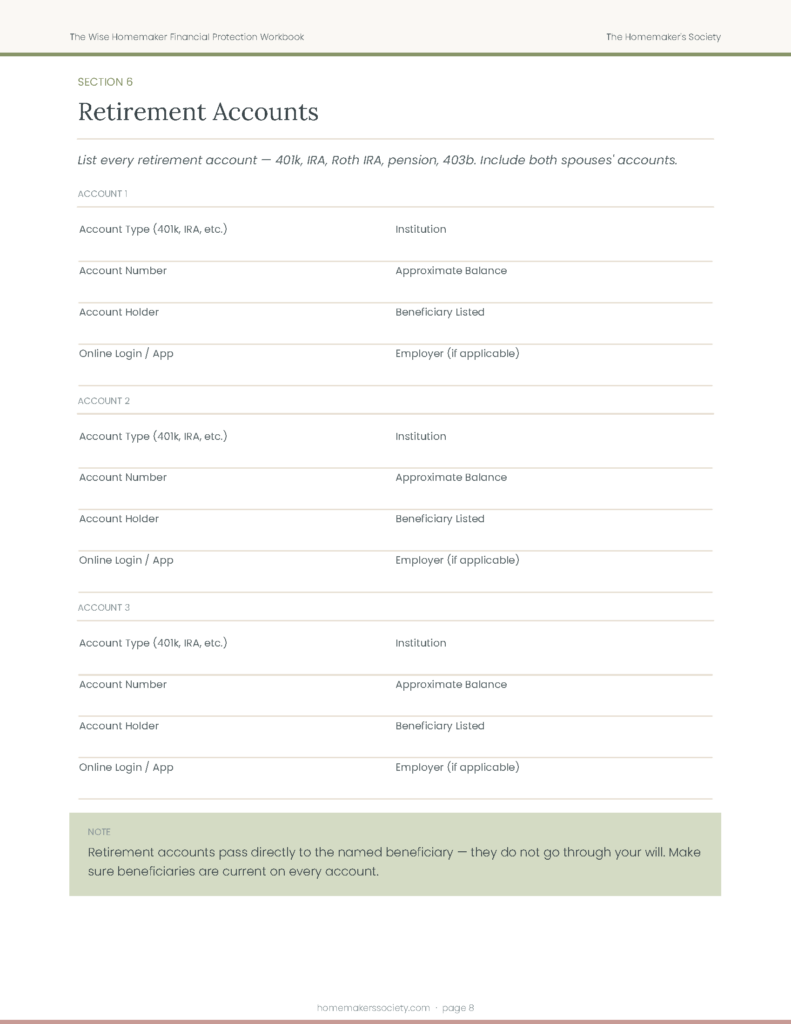
- Retirement accounts — 401k, IRA, pension
- Social Security cards for every family member
- Birth certificates and marriage certificate
- Tax returns from the last three years
If you don’t have a household notebook section for this, start one today. The printables in the members-only homemaking library have exactly the right pages for this. Fill them out and put them somewhere your husband knows about, too.
related: How to Build a Simple Home Budget
#2 Understand Your Life Insurance
Most homemakers know their family has life insurance. Fewer know what it actually covers.
Here’s what you need to know — not as an expert, but as the manager of your household:
Is there enough? A general rule of thumb is 10-12 times the primary earner’s annual income. If your husband passed away tomorrow, would the benefit cover your mortgage, your children’s needs, and give you time to stabilize before you had to make major decisions? If you’re not sure, that’s the conversation to have.
Is your homemaking insured? This surprises people. Your labor as a homemaker has real economic value — childcare, cooking, cleaning, household management, transportation. If you passed away tomorrow, your husband would have to pay someone to do much of what you do. Life insurance on a stay-at-home spouse is not unusual and is worth having the conversation about.
Where is the policy? Know the company name, the policy number, and how to file a claim. Write it down somewhere accessible.
#3 Have Your Own Credit History
This is the one most homemakers haven’t thought about — and it matters more than almost anything else on this list.
Credit history is built individually, not jointly. If you have been a stay-at-home homemaker and your name is not on any accounts, you may have little to no credit history of your own. That means if you ever needed to rent an apartment, buy a car, or establish financial independence for any reason — including a husband’s death or disability — you would be starting from zero.
The fix is simple. If you don’t have a credit card in your name, get one. Use it for small purchases you’d make anyway — groceries, gas — and pay the balance in full every month – don’t carry a balance or go into debt. You don’t want to be paying interest. That builds credit history in your name without carrying debt.
If your husband has existing accounts, ask whether you can be added as a joint account holder rather than just an authorized user. Joint account holders build credit history. Authorized users typically do not.
This is not a lack of trust in your marriage. It is wisdom. The Proverbs 31 woman had her own financial activity — she bought fields, she traded, she earned. Having your own credit history is the modern equivalent.
#4 Understand Your Social Security Situation
This is the section most homemakers skip — and the one that catches women most off guard later in life.
Social Security benefits are calculated based on your own earnings record. If you have been a full-time homemaker for many years, your own record may be thin or nonexistent. Here’s what you need to know:
Spousal benefits exist. As a spouse, you may be entitled to up to 50% of your husband’s Social Security benefit at his full retirement age, even if you have never worked outside the home. This is not charity — it is a benefit you are entitled to as a spouse.
Survivor benefits also exist. If your husband passes away, you may be entitled to his full benefit amount as a surviving spouse, depending on your age and circumstances.
Divorced spouse benefits exist. If you were married for at least 10 years and later divorced, you may still be entitled to spousal or survivor benefits based on your former husband’s record — even if he has remarried.
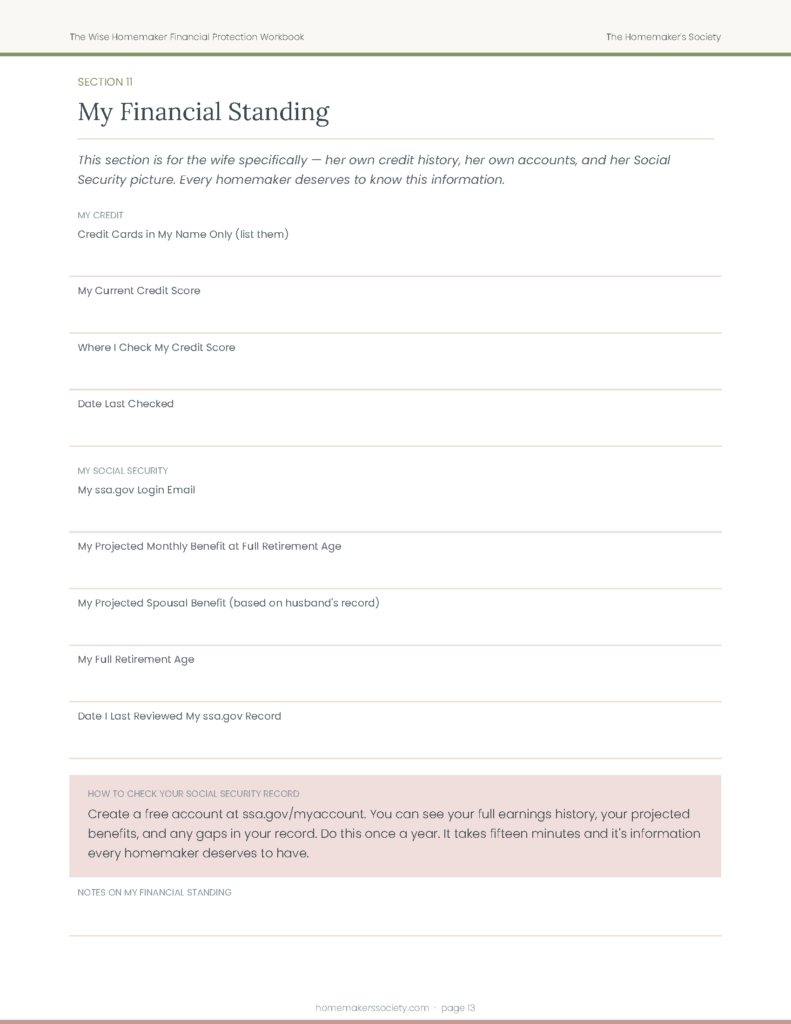
You can create a free account at ssa.gov to see your own earnings record and projected benefits. Do this. Know what’s there. It takes fifteen minutes and it’s information every homemaker deserves to have.
#5 Know What Your State Says About Marital Assets
I want to be clear: I am not a lawyer, and this is not legal advice. But I do think every homemaker should understand one basic thing about the laws in her state.
Most states treat assets acquired during a marriage as marital property — meaning both spouses have a legal claim to them regardless of whose name is on the account or whose paycheck funded them. But the specifics vary significantly by state. Community property states divide marital assets differently than equitable distribution states. What you’re entitled to in a divorce, and what protections exist for a surviving spouse, depend on where you live.
You don’t need to become an expert. You just need to know enough to have an informed conversation with an attorney if you ever need one. An hour with a family law attorney in your state — even just to understand the basics — is worth far more than most women think.
#6 Have the Conversation With Your Husband
Everything in this post requires a conversation. And I want to help you frame it, because I know this can feel uncomfortable.
This is not a conversation about distrust. It’s not “what happens if we divorce” or “what if you die.” It’s a stewardship conversation. It sounds like this:
“I want to make sure I know where everything is so that if something ever happened to you — an accident, a health emergency, anything — I could handle things without being in the dark. Can we sit down together and make sure I know where our accounts are, where the insurance policy is, and where our important documents are kept?”
Most husbands, when approached this way, are relieved. Because they’ve probably thought about this too. And they love you. They don’t want you to be in the position of not knowing.
Make it a date if you have to. Order dinner in, put the papers on the table, and spend an hour making sure you both know where everything is. Then put it all in your household notebook and update it once a year.
related: What It Means to Have an Abundant Home
The Wise Homemaker Knows Her House
She considers a field and buys it. She sees that her trading is profitable. She is clothed with strength and dignity. The Proverbs 31 woman was not financially naive. She was a full participant in the stewardship of her family’s resources — not because she didn’t trust her husband, but because wisdom requires it.
You work hard. You pour your days and your years into your home and your family. That work has value — financial value that is real and significant, even if it never appears on a pay stub. Knowing your family’s financial picture doesn’t diminish your role as a homemaker. It deepens it.
This is part of what it means to be a wise woman who builds her house.
A Financial Workbook for Homemakers
If you read through this post and felt the weight of how much you don’t know — that’s exactly why I created the Wise Homemaker Financial Protection Workbook.
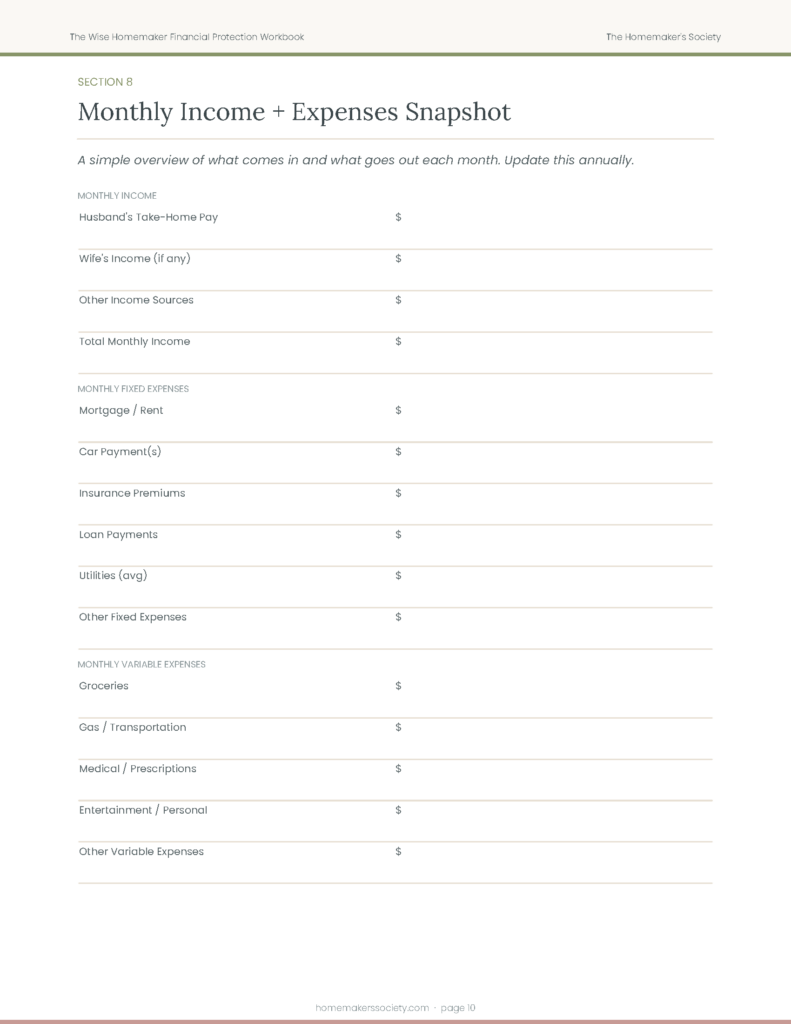
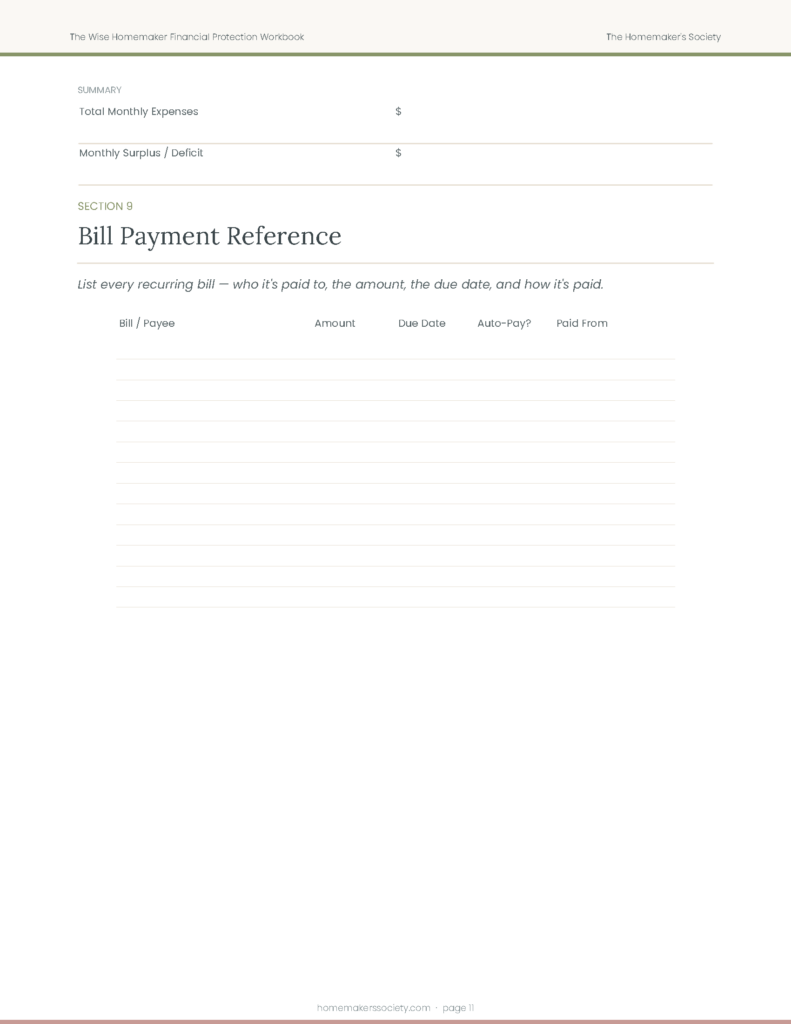
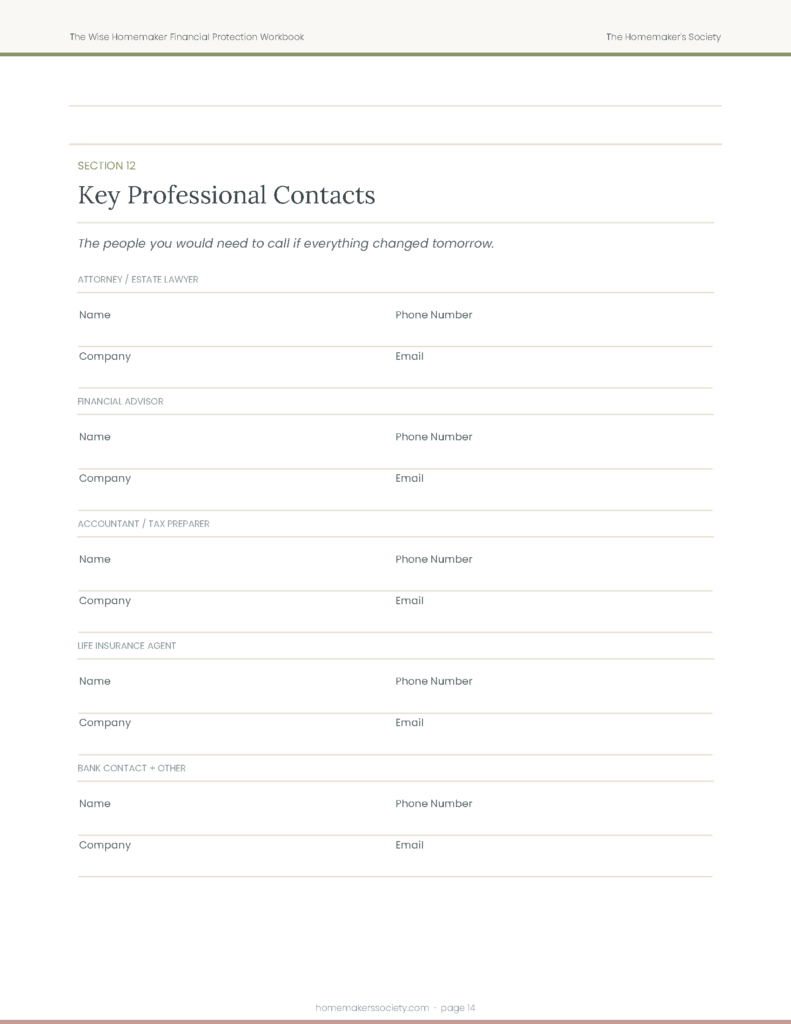
It’s a complete, printable workbook designed for homemakers who want to understand their family’s full financial picture and have everything documented in one place. Not scattered across filing cabinets and old emails — in one place, organized, accessible.
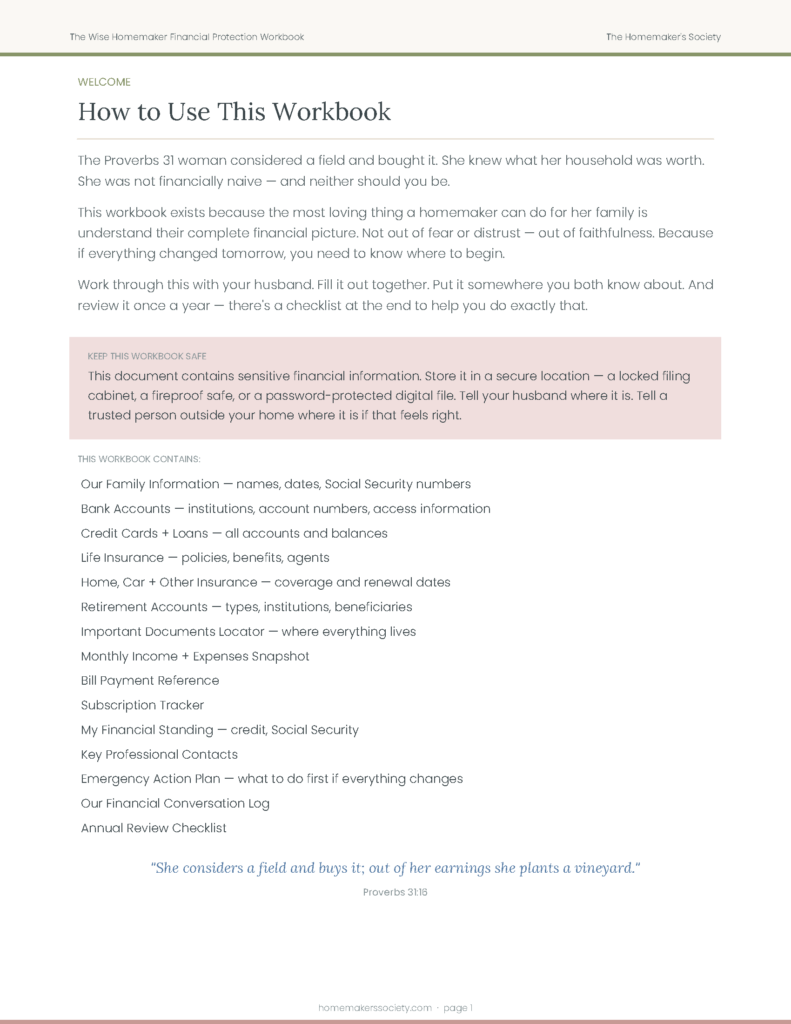
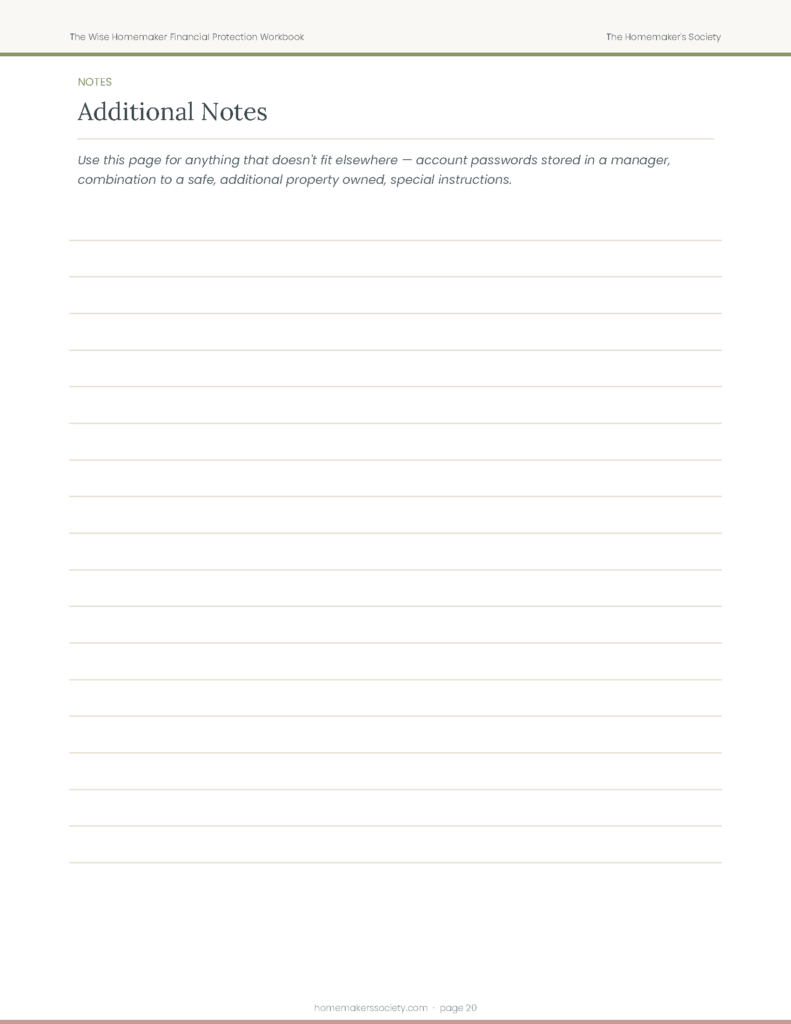
Here’s what’s inside the 21 pages:
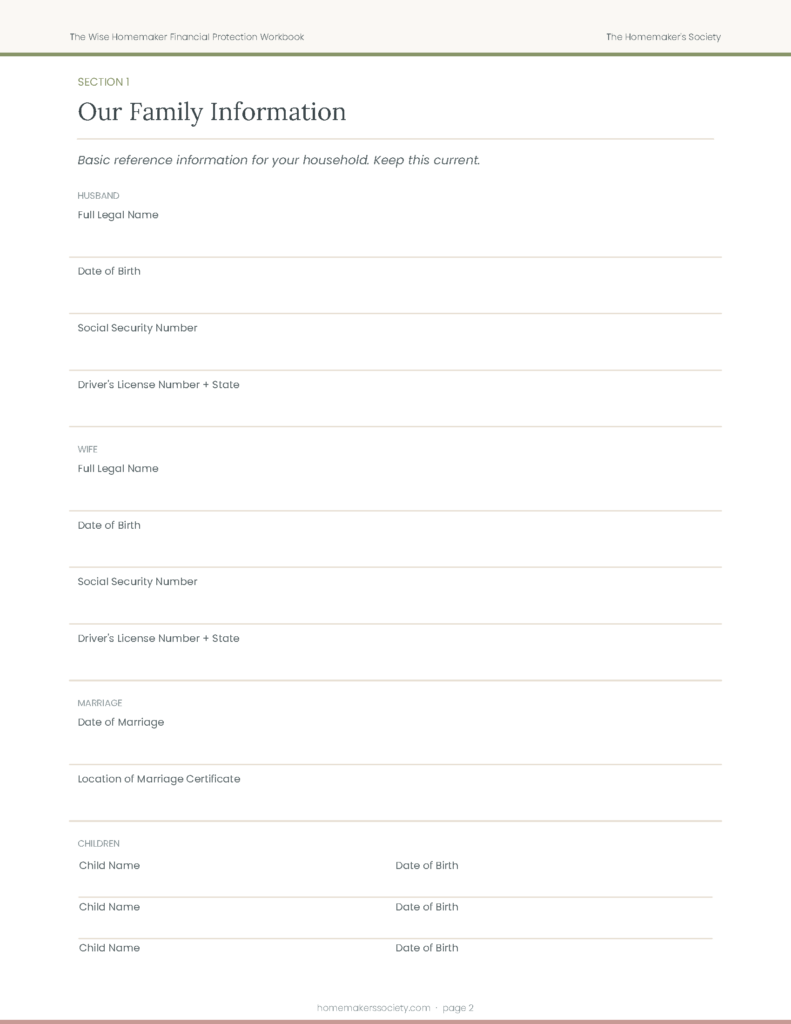
- Our Family Information — names, dates, Social Security numbers
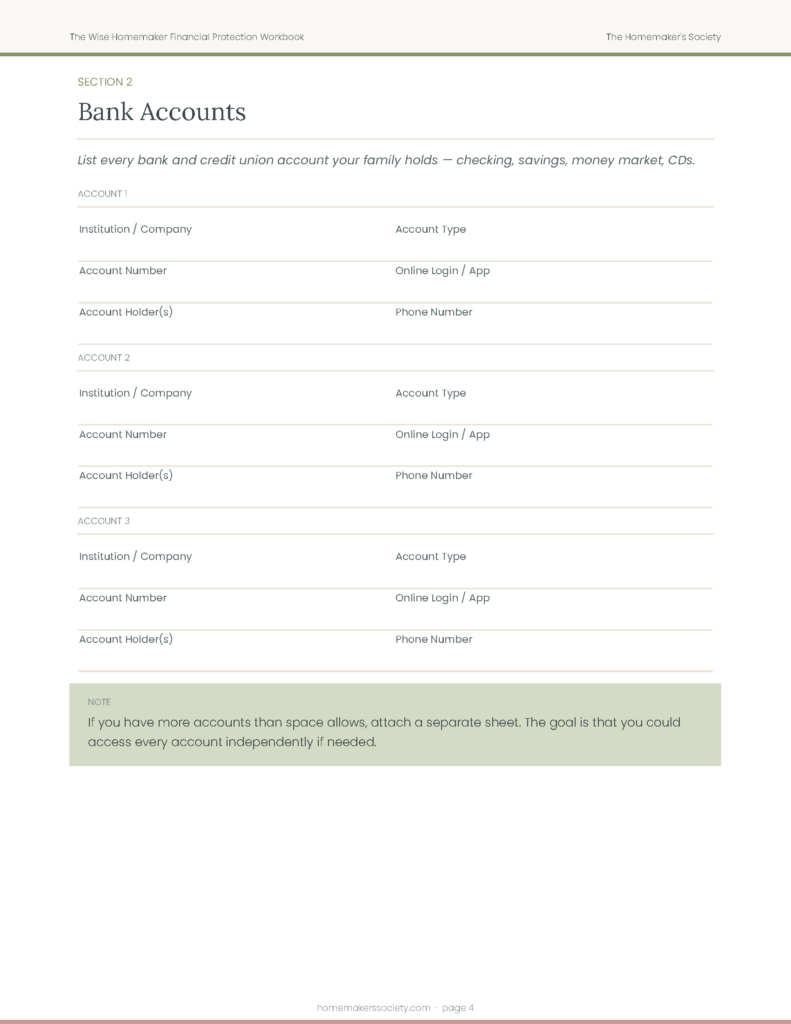
- Bank Accounts — institutions, account numbers, how to access them
- Credit Cards + Loans — every account in one place
- Life Insurance — policies, benefit amounts, agent contacts
- Home, Car + Other Insurance — coverage and renewal dates
- Retirement Accounts — types, institutions, beneficiaries
- Important Documents Locator — where the will, deed, titles, and certificates live
- Monthly Income + Expenses Snapshot
- Bill Payment Reference
- Subscription Tracker
- My Financial Standing — your credit and Social Security information
- Key Professional Contacts — attorney, financial advisor, accountant
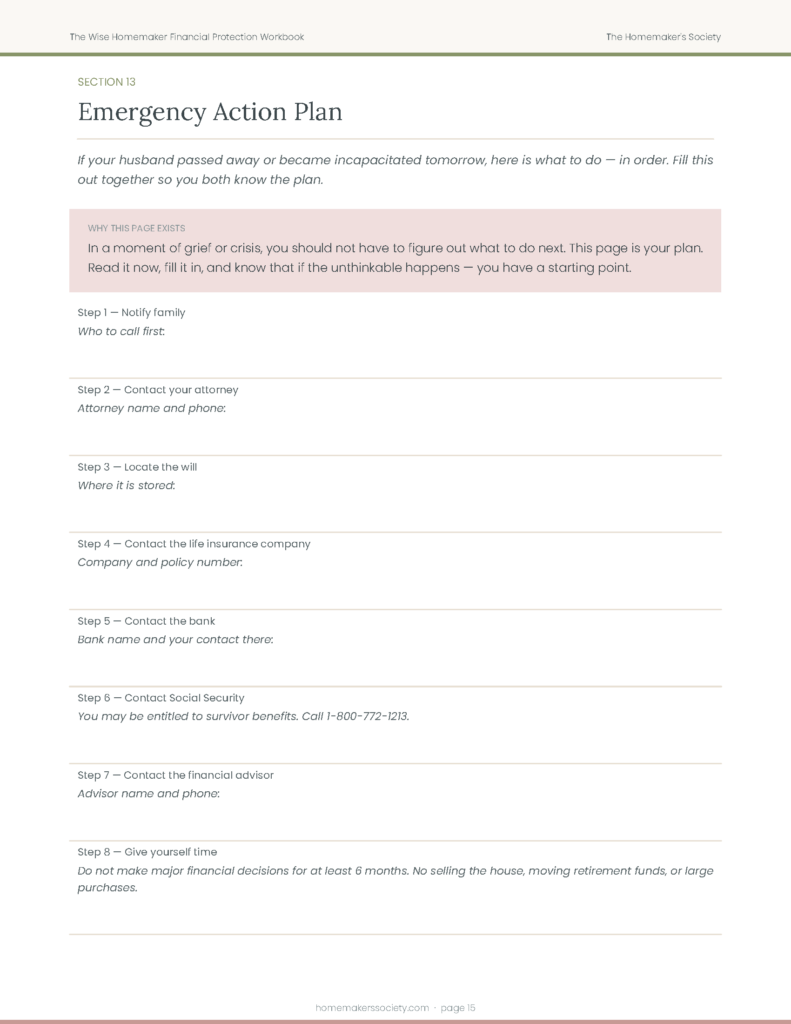
- Emergency Action Plan — step by step, what to do first if everything changes
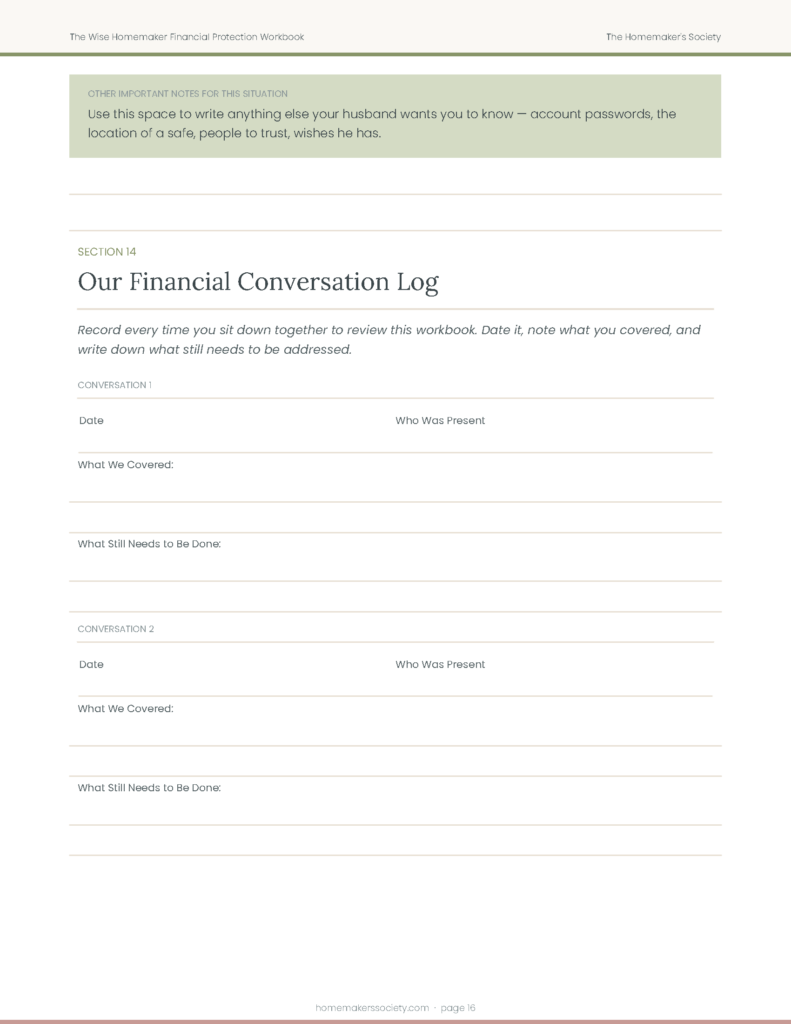
- Our Financial Conversation Log
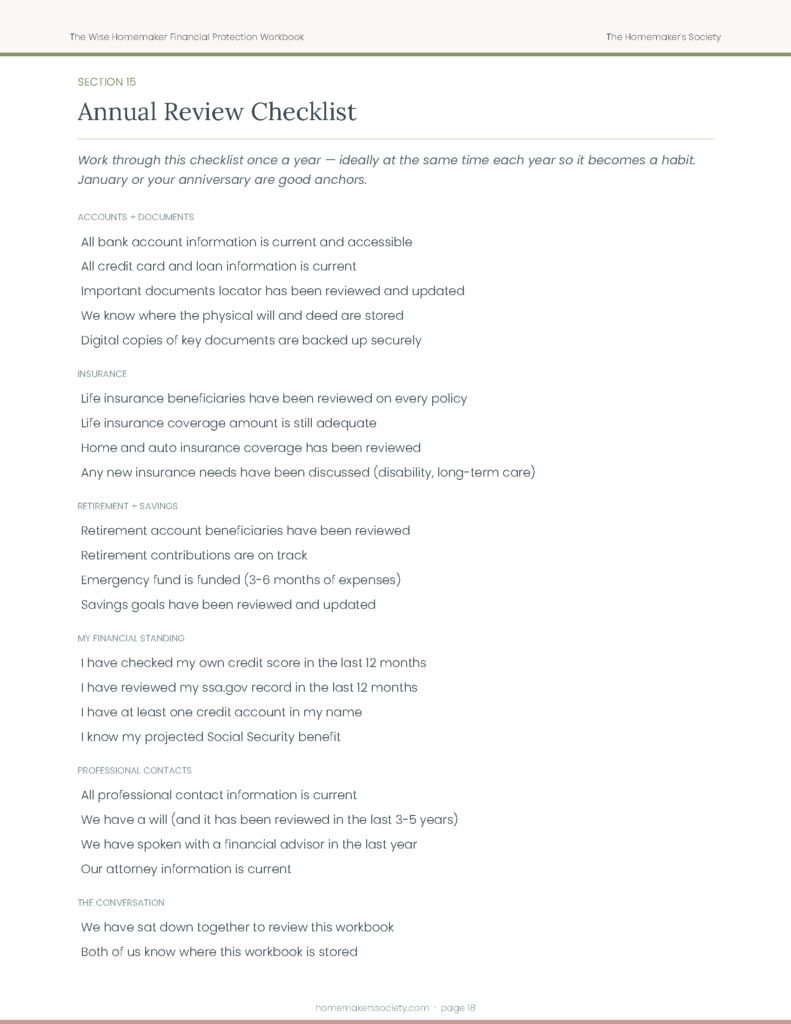
- Annual Review Checklist
That last one — the Emergency Action Plan — is the page I wish every homemaker had filled out before she needed it. It’s a step-by-step guide for what to do first if your husband passes away or becomes incapacitated. Not because you’re planning for the worst. Because a woman who loves her family plans for every season.





Get the Printable Workbook
The workbook is available in the member library — find it in the Fireside Room under Home Economy + Budgeting.
Note: If you’re not yet a member, you can find it in the shop available for purchase as well.
Resources for Further Reading
- My Social Security Account — Create a free account to view your earnings record and projected benefits.
- Social Security Survivor Benefits — Learn what you may be entitled to as a surviving spouse.
- Social Security Spousal Benefits — Understand what spousal benefits exist and how they work.
- Annual Credit Report — The only federally authorized site for free credit reports from all three bureaus.
- Consumer Financial Protection Bureau — Plain-language guides on credit, debt, and your financial rights as a consumer.
- Nolo — Plain-language legal guides on wills, trusts, estate planning, and divorce law by state. Not a substitute for an attorney, but excellent for understanding the basics before you meet with one.
- Life Happens — A nonprofit with a life insurance needs calculator and plain-language explainers. No sales pressure.
- National Association of Insurance Commissioners — Helps consumers understand insurance policies and file complaints if needed.
- Find a Certified Financial Planner — Search for a fee-only planner in your area who doesn’t earn commissions on what they sell you.
- Modern Widows Club — Community and practical resources specifically for women navigating widowhood.
- WomensLaw.org — Legal information written in plain language for women, organized by state.
- DivorceCare — Christian-based support groups and resources for women navigating divorce.


